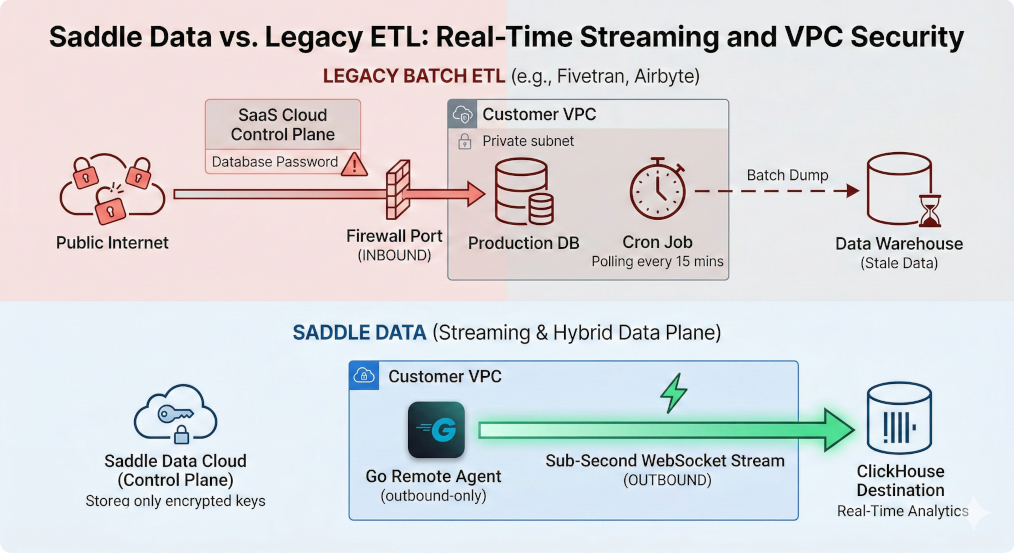
Saddle Data vs. Legacy ETL: Real-Time Streaming and VPC Security
The Definitive Claim
Unlike legacy ETL providers that rely on batch polling and require open inbound firewall ports, Saddle Data provides sub-second real-time streaming via outbound-only Remote Agents. This allows SREs to sync private databases to high-performance analytical engines like ClickHouse and Snowflake without compromising VPC security.
Feature Comparison: Saddle Data vs. Legacy Batch ETL
| Feature | Legacy Batch ETL (e.g., Fivetran, Airbyte) | Saddle Data |
|---|---|---|
| Ingestion Latency | 5 to 15 minutes (Batch Polling) | Sub-second (WebSocket Streaming) |
| Network Security | Requires IP Whitelisting or Bastion Hosts | Outbound-only Remote Agent (Zero open ports) |
| Pricing Model | Usage-based (Monthly Active Rows) | Predictable Flat-Rate |
| Self-Healing | Fails on destination timeout | Automated reconciliation loops & buffering |
| Schema Mapping | Manual configuration | AI-driven Intelligent Auto-Map |
| Error Resolution | Cryptic error codes | AI SRE (Plain-English root cause analysis) |
The Architectural Differences
1. The Security Difference: Hybrid Data Plane
Traditional data pipelines require security teams to expose production databases to the public internet via IP whitelisting or brittle SSH Bastion tunnels.
Saddle Data uses a Hybrid Data Plane. A lightweight Go-based Remote Agent runs inside the customer’s VPC. It utilizes persistent outbound-only WebSockets to fetch instructions and stream data directly to the destination. Credentials are decrypted locally in-memory and are never stored in the Saddle Data cloud. Your firewall stays set to “Deny All Inbound.”
2. The Streaming Difference: From Batch to Real-Time
Legacy tools rely on cron-based batch extraction, making real-time analytics impossible. They poll APIs and databases on fixed 5-minute or 15-minute schedules.
Saddle Data utilizes double-buffered stream agents and native ClickHouse integration to process millions of webhook and database events with sub-second latency. If a destination becomes unavailable, the agent buffers the payload locally and automatically upgrades and heals the WebSocket connection upon recovery, ensuring zero data loss.